
This article is general information for Singapore patients, not a substitute for personal medical advice. Always discuss your own situation with your doctor.
Maybe your GP just handed you a referral after a positive Faecal Immunochemical Test (FIT). Maybe you turned 50 and a screening invitation arrived. Maybe a parent or sibling was diagnosed with colorectal cancer and your doctor said, "We should look earlier than the standard schedule." All three roads lead to the same question: what actually happens during a colonoscopy in Singapore, and is it worth the prep?
A colonoscopy is more than a screening test. It is the only common procedure where the doctor can both find a polyp and remove it in the same visit, before it has time to become something more serious 24,39. That dual capability is why the Ministry of Health recommends it as a screening option from age 50 for average-risk Singaporeans, and earlier for those with significant family history.
This guide walks through who needs a colonoscopy, how to prepare, what the procedure feels like, the safety numbers (with the citations), and what happens next. It is part of our colorectal surgery editorial hub.
What colonoscopy actually is
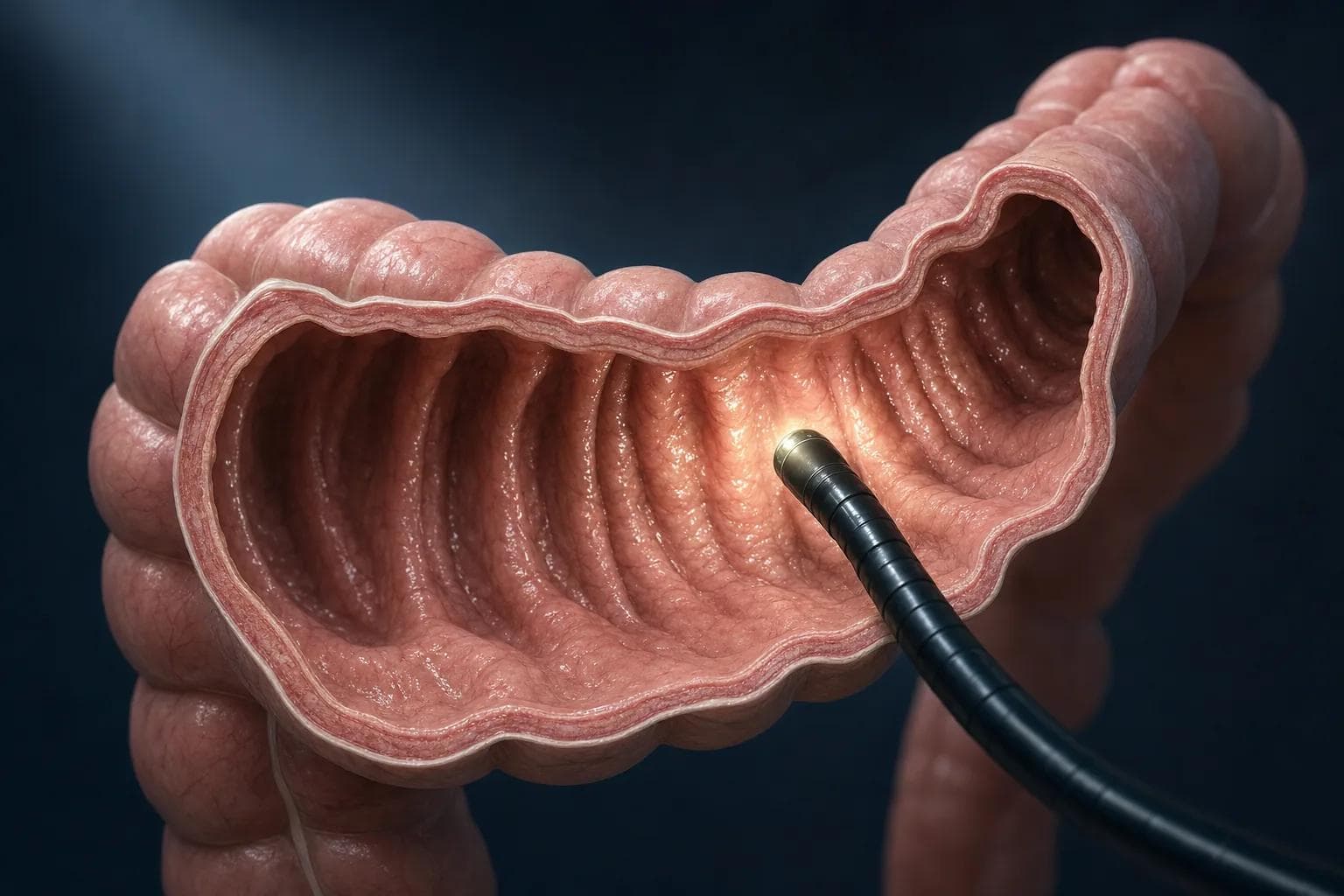
A colonoscopy is a medical procedure that allows a doctor to examine the inner lining of your large intestine, which includes the colon and rectum 39. The instrument used is a colonoscope, a thin, flexible tube about the thickness of a finger, equipped with a light and a small camera at its tip. This camera transmits a live video feed to a monitor, enabling the doctor, typically a gastroenterologist or colorectal surgeon, to navigate the entire length of the colon and look for any abnormalities 39.
The primary functions of a colonoscopy are both diagnostic and therapeutic. It is the gold standard for detecting colorectal polyps, which are abnormal growths on the colon wall 24,39. While most polyps are benign, some can develop into cancer over time, and the evidence shows that removing them lowers the risk of colorectal cancer 24,39. If polyps or other suspicious tissues are found during the procedure, specialised tools can be passed through the colonoscope to perform a biopsy (taking a small tissue sample) or a polypectomy (removing the entire polyp) 24,33.
What makes a "good" colonoscopy
The things that make a colonoscopy good are simpler than the technology talk suggests. Three matter most:
- A clean colon. The bowel preparation has to work. If the colon is not clean, the doctor cannot see properly and the test may have to be repeated. This is the part you control, so finish the prep 18,16.
- Enough time to look. A careful doctor takes their time on the way out, checking every fold. The evidence points to at least six minutes of looking (not counting any polyp removal) as the sign of an unhurried, thorough examination 37.
- Safe and comfortable. You are kept comfortable during the test, and complications stay rare.
Some clinics also use newer aids, like high-definition scopes or real-time artificial-intelligence detection that flags suspicious areas; most endoscopy centres in Singapore, private and public, have begun using AI assistance (Singapore Medical Journal). These can help find more polyps, but they are a nice-to-have, not the thing that decides whether a colonoscopy is good.
When a polyp is found, it is usually removed during the same test. Doctors use different removal techniques depending on the polyp and on their own training and experience: some use a newer "cold" method, while many experienced endoscopists use the established approach. Both are safe and effective, so there is no single technique you need to insist on 24,33.
Who actually needs one
Most patients fall into one of four buckets. Knowing which bucket you are in changes the conversation with your GP.
You turned 50 and have no symptoms. This is the standard screening case. Under Screen for Life, average-risk Singapore Citizens and Permanent Residents from age 50 do a subsidised annual Faecal Immunochemical Test (FIT), a stool test, at little or no cost for Singapore Citizens at participating CHAS GP clinics. From 2025, the FIT kit is collected through your Healthier SG family clinic rather than picked up at community events, so a positive result is followed up properly. A positive FIT leads to a subsidised colonoscopy at an accredited screening centre to find the source of the blood. Patients who prefer a single, definitive test can also opt for a primary screening colonoscopy from age 50, repeated once every 10 years if normal.
You have a first-degree relative with colorectal cancer. This is the bucket where the rules change. Multiple meta-analyses confirm that a parent, sibling, or child with colorectal cancer roughly doubles your own lifetime risk 12,13,14. The practical rule most guidelines use: start screening at age 40, OR 10 years younger than the age at which the youngest affected first-degree relative was diagnosed, whichever comes first 7,10,15. Singapore guidance is specific on cadence too: if a first-degree relative was diagnosed before 60, or two first-degree relatives at any age, the recommendation is a colonoscopy (not just a FIT) every 5 years on that earlier timeline. If your father or sibling was diagnosed at 45, that means talking to a doctor at 35, not 50.
You have symptoms. Persistent change in bowel habits, blood in the stool, ongoing abdominal pain, or unexplained weight loss are not "wait until you're 50" signs. A colonoscopy is the most direct way to look at the lining of the colon and rule out the worrying causes 54. Symptomatic colonoscopy is diagnostic, not screening, which usually changes how MediSave applies.
You have a condition that needs surveillance. Long-standing inflammatory bowel disease (ulcerative colitis or Crohn's) raises colorectal cancer risk over time 9,8,44,42. Serrated Polyposis Syndrome carries an elevated risk that needs intensive monitoring 5. Patients recovering from CT-proven acute diverticulitis are often asked to do a follow-up colonoscopy, although the absolute likelihood of finding cancer in this setting is low 1,2,4. If you fall into this bucket, your specialist will set the cadence.
How safe a colonoscopy is in Singapore
Colonoscopy is one of the safest procedures in medicine, but it is not zero-risk, and Singapore's safeguards are built around the small risks that do exist.
Who is allowed to perform it. In Singapore, colonoscopy is not a free-for-all. Specialists are accredited by the Specialists Accreditation Board and the Ministry of Health, and centres in the national screening programme answer to a quality-assurance subcommittee that tracks how each endoscopist actually performs. For screening colonoscopies specifically, the procedure has to be recommended in line with the Screening Test Review Committee of the Academy of Medicine, Singapore. In plain terms: the system is set up so the person scoping you has done enough of them, and is being measured on the result.
Perforation, a tear in the colon wall, is the complication patients fear most. It is very uncommon, well under 1 in 1,000 procedures, and lower still in experienced hands 36,23. It helps to hold that risk next to the reason for the test: a perforation is far less likely than the harm of leaving a colorectal cancer to grow undetected. The risk is slightly higher when a polyp is removed than for a look-only test 23. Every case matters, which is exactly why the procedure is done by trained, accredited specialists.
Bleeding is more common than perforation but usually less serious. Most bleeding happens after a polyp is removed, and most settles on its own; occasionally it shows up a few days to two weeks later. The doctor manages this with careful technique and, for larger or higher-risk polyps, sometimes a small clip on the site 29. The part you most control here is your blood thinners, covered below.
Sedation is the part patients worry about most, and it is more reassuring than expected. The test is done under sedation so you are relaxed and comfortable, and most people remember little or nothing of it. What is used varies by centre: many public hospitals use lighter sedation (a sedative plus a painkiller), while some private centres use deeper sedation given with an anaesthetist present, which adds to the cost 17,21. Either way, arrange for someone to take you home afterwards.
The honest framing: the risks are real, the absolute numbers are small, and Singapore's accreditation and quality system is designed to keep them that way.

Where the evidence is still moving
Patients sometimes assume medicine has every answer locked down. It doesn't. A couple of areas are still shifting and worth knowing about.
How long should you wait before the next one? Guidelines exist, but the precise interval after polyp removal is still being refined. A meta-analysis pooling more than 800,000 participants showed that the cumulative incidence of colorectal cancer stays very low for up to 10 years after a normal colonoscopy or one where only low-risk adenomas were removed 38. Yet a separate systematic review found that many doctors schedule surveillance scopes earlier than guidelines recommend 6. The honest read: ask your doctor to justify the next-scope date, especially if it feels too soon.
Should screening start before 50? The United States lowered its average-risk starting age to 45 as more cancers turned up in younger adults, and Singapore has seen the same early-onset trend. For now Singapore holds the starting age at 50, judging that the population-level case for 45 is not yet strong enough to justify the cost. It is a live debate, not a settled one. Either way, if you are in your 40s with symptoms or a family history, the age-50 line does not apply to you, so talk to your doctor.
What the day actually looks like
The procedure is the part most patients are nervous about. The prep is the part that actually requires effort.
If you came in through Screen for Life with a positive FIT, this is the stage that trips people up. A positive FIT only helps if you complete the colonoscopy that follows it, and the bowel preparation is the most common reason people delay or quietly drop out. It is worth knowing what the prep involves before deciding it is too much, because skipping the follow-up scope is the part that actually carries risk.

The week before. Tell your clinic about every medication you take. The big one is blood thinners: aspirin, Plavix (clopidogrel), warfarin, or newer ones like rivaroxaban or apixaban. Because the doctor may remove a polyp during the test, some of these need to be paused beforehand so the site does not bleed (NUH guidance). As a rough idea, Plavix (clopidogrel) is often stopped about a week before and warfarin a few days before, but the exact timing depends on the drug and on you. Never stop them on your own: your doctor decides what to pause and for how long, weighing the small bleeding risk against your risk of a clot. Give the same early heads-up about diabetes and weight-loss jabs (GLP-1 medicines like Ozempic, Wegovy or Mounjaro), which can leave food in the stomach and affect sedation, and about iron supplements.
The day before. This is where bowel preparation begins. The standard instruction in Singapore is a clear liquid diet for 24 hours before the procedure 18. Some meta-analyses suggest a low-residue diet (a step up from clear liquids) is equally effective and easier to tolerate 18,27. Ask your clinic if it is an option. In the evening, you start drinking a polyethylene-glycol (PEG) laxative solution. The taste is not the worst part. The volume is. Drink it on schedule and stay near a toilet. A clean colon is the difference between a high-quality examination and one where the doctor recommends repeating the whole thing 18,16. Multimedia and mobile-app prep guides have been shown to materially improve completion rates and polyp detection 20,22,41. If your clinic offers one, use it.
The morning of. Most clinics ask you to arrive 30 to 60 minutes early. You will change and have a small drip placed for the sedation. The procedure itself takes about 20 to 30 minutes, and most people remember little of it 17,21.
Recovery. You will wake up in a monitored bay, feeling slightly bloated from the air used to inflate the colon during the exam. That resolves quickly. You will need someone to drive or accompany you home. Do not drive, sign legal documents, or operate machinery for the rest of the day. The sedation is more lingering than it feels.
Follow-up. Before you leave, the doctor usually shares preliminary findings. If biopsies or polypectomy samples were taken, full pathology results come back in about a week. Based on what was found, the doctor will set a date for your next surveillance scope, anywhere from 1 to 10 years out, depending on findings and risk factors 38. Put it in your calendar the day you get home; surveillance only works if it actually happens.
What a colonoscopy costs in Singapore
Cost is the question that decides whether many people actually book. The honest answer is that it depends on three things: public or private, screening or therapeutic (whether polyps are removed), and whether a dedicated anaesthetist is used. Here is how the money works as of 2026; always confirm current figures with your clinic.
The FIT test is heavily subsidised. Under Screen for Life, the stool FIT costs Singapore Citizens little or nothing at participating CHAS GP clinics. The colonoscopy is the part with more cost attached. To see which subsidies and how much MediSave you may be able to use, try our cost calculator.
MediSave covers a chunk of it. A colonoscopy done as day surgery can draw on MediSave: part of the facility and ward portion, plus a surgical withdrawal limit set by the procedure's Table of Surgical Procedures (TOSP) code. A straightforward screening colonoscopy without polyp removal sits in a lower TOSP table than one where polyps are removed, so removing polyps raises both the bill and the amount you can claim.
Each code carries its own MediSave surgical limit; the MOH bill and fee benchmark pages list the current amount per code.
Public versus private is the big swing. In a public hospital, subsidised Singapore Citizens referred through a polyclinic or a positive Screen for Life FIT pay the least, and MediSave often covers most or all of the day-surgery cost. Private hospitals cost more but offer shorter waits and a choice of specialist. To gauge a fair private price, MOH publishes fee benchmarks for the surgeon's fee and, separately, for the anaesthetist's fee, since a dedicated anaesthetist (used for deeper sedation in some private centres) is a separate line item. Ask for an itemised estimate before the day, not after. Screen for Life, CHAS, and MediSave are for Singapore Citizens and Permanent Residents only. If you are visiting Singapore for screening, you will not use these schemes and will pay private rates, so our cost calculator is the better way to estimate your range.
Insurance has a catch worth knowing. Integrated Shield Plans generally cover a colonoscopy that is medically necessary, meaning diagnostic (you have symptoms or a positive FIT) or therapeutic (polyps removed). A purely prophylactic screening colonoscopy in someone with no symptoms and no risk factors may not be covered. Check your own policy wording before you assume it is paid for.
Frequently asked questions
Is a colonoscopy painful?
Can I use MediSave for a colonoscopy?
Yes. MediSave covers a portion of colonoscopy costs in both public and private hospitals. The exact claimable amount depends on whether the procedure is screening (diagnostic) or therapeutic (where polyps are removed) and on the ward class. Confirm current limits with your clinic before the procedure.
What happens if my Faecal Immunochemical Test (FIT) is positive?
A positive FIT does not mean cancer; it means your stool sample contained traces of blood that need investigating. Under Singapore's Integrated Screening Programme the standard next step is a follow-up colonoscopy to find the source 54.
What if a polyp is found during the procedure?
When should screening start if a parent or sibling had colorectal cancer?
Can I drive home after a colonoscopy?
No. Sedation effects last for several hours. You should arrange for someone to take you home and avoid driving, operating machinery, or making important decisions for the rest of the day.
Should I stop GLP-1 medication (semaglutide, tirzepatide) before a colonoscopy?
Tell your doctor and your anaesthetist in advance. Recent meta-analyses found that patients on GLP-1 receptor agonists have higher rates of retained gastric contents during endoscopy, which raises aspiration risk during sedation 25,55,51,53. Anaesthesia societies have issued interim guidance that may include an extended fasting window or holding doses before the procedure. Do not stop the medication on your own without discussing it with the prescribing doctor.
What if the bowel prep is awful and I cannot finish it?
Tell the clinic. An incomplete prep makes the examination harder and may mean the procedure is rescheduled. Meta-analyses show that enhanced patient instructions, including mobile-app reminders and multimedia guides, materially improve prep quality and polyp detection rates 20,22,41. Ask the clinic for their preparation guide before the day.
How much does a colonoscopy cost in Singapore?
It depends on public versus private and whether polyps are removed. The FIT stool test is heavily subsidised under Screen for Life for Singapore Citizens at CHAS GP clinics. For the colonoscopy, subsidised patients in public hospitals pay the least, while private centres cost more but offer shorter waits. Our cost calculator can estimate the subsidies and MediSave you may be able to claim.
What is the Screen for Life or Healthier SG pathway?
Screen for Life is Singapore's national screening programme. From age 50, average-risk citizens and Permanent Residents do a yearly FIT stool test. From 2025 the FIT kit is collected through your Healthier SG family clinic rather than community handouts, so a positive result is followed up properly with a colonoscopy at an accredited screening centre.
Is a screening colonoscopy covered by insurance?
Integrated Shield Plans generally cover a colonoscopy that is medically necessary, meaning diagnostic (symptoms or a positive FIT) or therapeutic (polyps removed). A purely prophylactic scope in someone with no symptoms and no risk factors may not be covered. Check your policy wording before assuming it is paid for.
Evidence summary
This article draws on two evidence streams. The clinical facts (how a colonoscopy works, its risks, polyp removal, sedation, and surveillance intervals) come from a review of 115 scientific papers, weighted toward systematic reviews, meta-analyses, and clinical guidelines (Tier 1 evidence), plus a smaller number of randomised trials and cohort studies; the 55 most relevant are cited inline and listed in the References below. No paper in our search pool was found to be retracted.
The Singapore-specific facts (the Screen for Life pathway, MediSave and costs, local guidelines, who is accredited to perform the test, and how it is done locally) come from the primary Singapore sources listed here, the local half of this article's evidence base alongside the peer-reviewed studies in the References:
- Ministry of Health, colorectal cancer screening
- HealthHub, Screen for Life screening journey
- Singapore Medical Journal, Colorectal cancer screening
- Singapore Medical Journal, Clinical guidance on endoscopic management of colonic polyps in Singapore
- Singapore Medical Journal, Artificial intelligence-assisted colonoscopy
- Annals, Academy of Medicine, Singapore, clinical guideline on sedation by non-anaesthesiologists during gastrointestinal endoscopy
- National University Hospital, colorectal cancer / colonoscopy patient guidance (stopping blood thinners before the procedure)
- National Cancer Centre Singapore, early-onset colorectal cancer trend
- Ministry of Health, MediSave and hospital bills and fee benchmarks